“Validated for
Confident Decisions”
We believe validation should be boring in the best way — provably safe, fully auditable, and resilient across providers and regions. That is the infrastructure we are building, one clean separation at a time.
Live Today
Capacity is spread deliberately across independent providers
— no single vendor is a single point of failure.
Comparison reflects architectural posture, not vendor benchmarks. “Common Setup” = a typical single-cluster, single-provider validator deployment.
Who We Are
FP Validated formally began scaling its team in 2026, but we are far from starting from scratch. Our team brings together leadership experience from one of Asia's largest validator companies, alongside veteran SREs who have operated hundreds of nodes under a SOC 2-compliant environment.
Our AUS is growing rapidly, and we are already working with institutions, VCs, and companies on white-label validator offerings and technical collaborations. With this foundation, FP Validated is positioned to become one of the most Prepared & Trusted validator partners for builders and institutions entering staking and blockchain infrastructure.
Former Head of Governance at A41.
Former Head of Validator and Tech Lead at A41; former Cloud Architect Engineer at Samsung SDS Research / Cloud Business Division.
Former SRE at A41; former node operator at Lambda 256.
Former node operator at DSRV and Shinlabs.
Former node operator at Shinlabs.
Co-founder and former Head of Research at A41.
Former researcher at Xangle.
Former researcher at A41.
What We Operate
We build every network on one Kubernetes-based, institution-grade operating model — Cosmos-SDK chains, Sui & Walrus, Canton, Ethereum and Solana, and ten mainnet EVM / RPC networks, all reconciled by Argo CD.
 Ethereum mainnet
Ethereum testnet
Ethereum mainnet
Ethereum testnet
 Solana testnet
 Canton Splice
 Sui mainnet
Sui testnet
Sui mainnet
Sui testnet
 Stable mainnet
Stable testnet
Stable mainnet
Stable testnet
 Sei mainnet
 LayerZero DVN · mainnet
 Walrus mainnet
Walrus testnet
Walrus mainnet
Walrus testnet
 Initia mainnet
Initia testnet
Ethereum
Initia mainnet
Initia testnet
Ethereum BSC Solana
 Hyperliquid
 Avalanche
 Polygon
 Arbitrum
 Optimism
 Base
Base Tempo
Tempo
Four Pillars of FP Validated
When you delegate stake, you are handing over a signing key and a slashing risk. Most outages are survivable; a double-sign or a leaked key is not. We built an operator whose entire architecture is organised around that single truth — safety before uptime theater.
Control / Workload
A hardened management plane governs identity, secrets and policy. Chains run on a separate workload plane. A management outage can never restart a validator.
Key Safety
Threshold signing, keys outside Kubernetes Secrets, no signer failover on an alert. Any signer-state change is a SEV-1 procedure, not routine ops.
Observability
Raw detail at the edge, low-cardinality summary at the center. Alerts explain; they never execute dangerous actions on their own.
Compliance
GitOps desired-state, tiered RBAC and audit evidence designed for SOC 2 / ISO 27001 from the first commit — verifiable, not just promised.
One Clean Seam
A managed control plane on Azure governs an external, multi-provider workload cluster — diff-only, with prune disabled. Two flows cross the seam, and nothing else.
Safety First
Signing keys are held in cloud KMS / HSM, sealed by HashiCorp Vault, and reached only through a Kubernetes-native key-management layer using short-lived workload identity — the raw key is never written to a pod or a Git repo.
The raw key never leaves the vault
Sealed, not stored
No single machine holds a usable key
Key access is bounded & audited
Raw at the Edge,
Summary at the Center
High-cardinality detail stays near the workload. Only low-cardinality fp:* summaries travel to the center — cheaper, and built for compliance evidence.
Explainable.
Reversible.
Every change is governed by its blast radius. The workload cluster runs diff-only, prune OFF — drift is reviewed, never blindly synced.
From Docs to Signer/Key
Join ≠ Activate
We Halt When Unsure
Safety First, Always
Value We Secure
Across the networks we validate and serve, this is the value riding on the infrastructure.
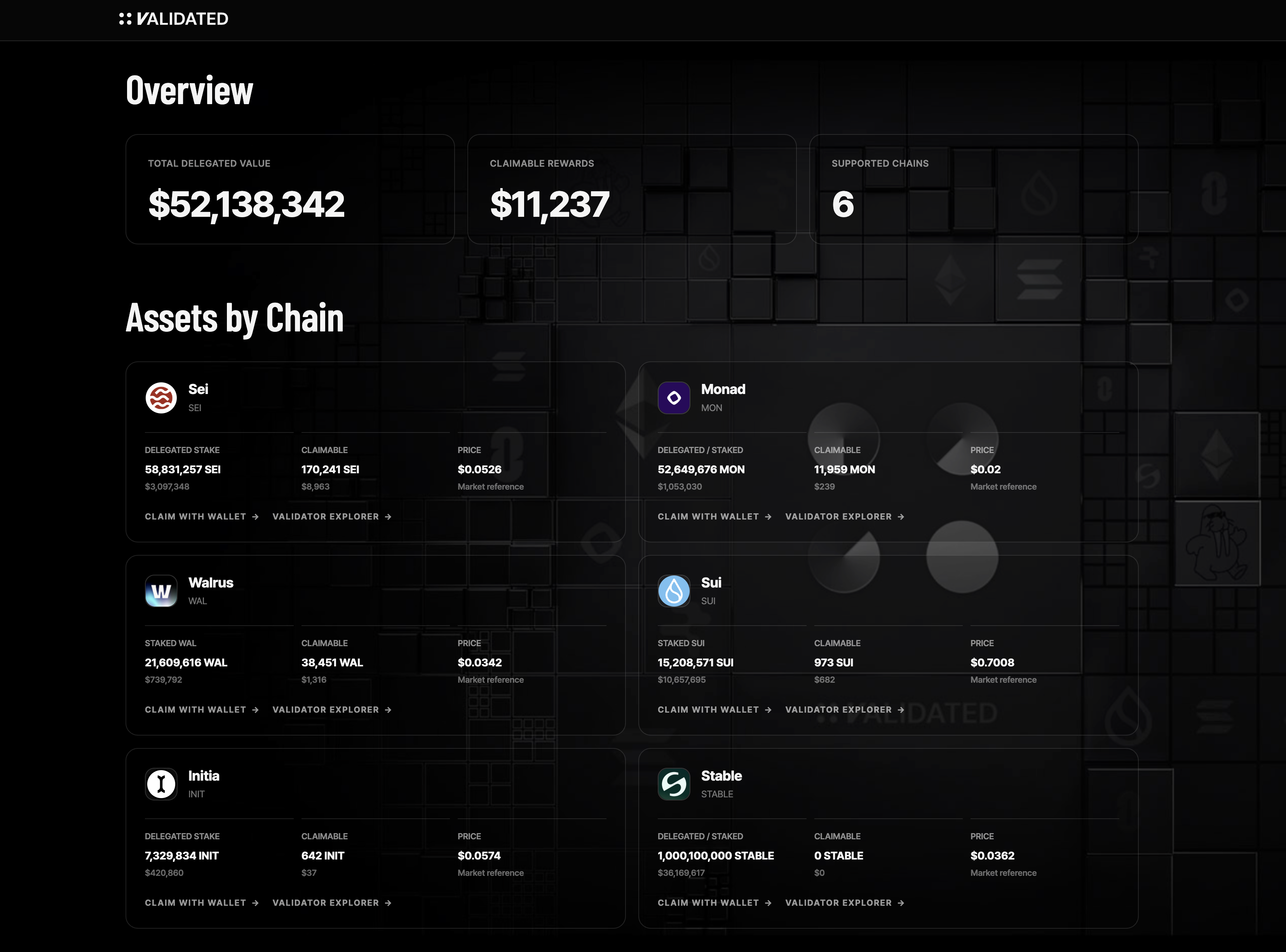
*Note: On Ethereum, we actively participate in Lido's CSM and IDVTC modules and are preparing non-custodial white-label staking solutions through stVaults. Through these initiatives, we aim to provide institutions and ecosystem partners with secure, scalable, and battle-tested staking infrastructure.
Validator Node Performance
Not claims — evidence. Swipe through public explorers and dashboards across the networks we run.
Our in-house operations tool tracks upgrade readiness and live resources / logs — the backbone of safety-first change management.
What's Next
Multi-Provider Platform
Two-plane architecture in production: validators across five providers, ten mainnet RPC endpoints, threshold signing on Cosmos-SDK chains.
Compliance Attestation
SOC 2 / ISO 27001 evidence packets, monthly access reviews, and continuous Azure inventory matured into formal audit readiness.
Region & Provider Expansion
Additional independent regions and bare-metal providers, with dedicated per-chain capacity sets and tighter private-access controls.
SOC 2 Type II Certification
Complete an independent SOC 2 Type II audit on top of our ISO 27001-aligned controls — formal assurance for institutional clients.